
By Coach Carlos | Olympic Athlete, Club Owner & Performance Coach
Sounds impressive. You’re investing $15,000 per year, but it’s worth it if your daughter gets a scholarship, right?
Here’s what they’re not telling you: Most of those “college placements” are walk-ons at Division III schools with zero scholarship money. And the ones who do get scholarships? They’re averaging $8,000 per year—barely covering textbooks.
By the time you discover this truth, you’ve already spent $60,000 chasing a return that was never coming.
I’m going to tell you what club directors won’t.
________________________________________________________________________________
Let’s do the math that clubs hope you never do.
What you’ll invest in club volleyball over 4 years:
$12,000-$18,000 per year × 4 years = $48,000-$72,000
What you’ll actually get back:
The average Division I volleyball scholarship (for the athletes who actually get one): $8,000-$12,000 per year
That’s $32,000-$48,000 over four years of college.
You’re paying more to chase the scholarship than the scholarship is worth.
But here’s the kicker: only 5-6% of high school volleyball players even play college volleyball at any level.
Of that 5-6%:
Translation: Your daughter has roughly a 0.5% chance of getting a meaningful Division I scholarship that makes your investment “worth it” financially.
But clubs aren’t selling you a 0.5% chance. They’re selling you certainty. They’re selling you “Our program develops college athletes.” They’re selling you showcase tournaments and recruiting databases and highlight videos.
They’re selling you hope. And hope is expensive.
Here’s what nobody tells you at tryouts: The club volleyball recruiting industrial complex makes more money from your dream than your daughter will ever get in scholarship dollars.
That showcase tournament in Vegas that costs your family $2,000? The club makes money. The tournament organizer makes money. The recruiting service makes money. The only person who doesn’t make money is your daughter—who has a 99.5% chance of not getting a meaningful Division I scholarship.
The system works perfectly. Just not for you.
Let me show you how this typically unfolds for families who invest in club volleyball expecting a scholarship return.
Picture this: Your daughter is 14, showing promise as an outside hitter. She’s 5’9″ now, might hit 5’11” or 6 feet. Good vertical. Consistent serve. Smart player. The kind of athlete who could realistically play college volleyball.
So you invest. Not recklessly, but strategically. You join a top club because “that’s where college coaches look.” You add private lessons to refine her approach. You hit every showcase tournament because “you never know who’s watching.” You sign up for a recruiting service because “we need to get her profile out there.”
Year 1 (Freshman): $12,000
Club fees, travel, training, gear. It’s an investment in her future, you tell yourself. She’s developing.
Year 2 (Sophomore): $14,000
Costs creep up. More travel. Better tournaments. Additional training. But she’s improving. It’s working.
Year 3 (Junior): $16,000
This is the crucial year. College coaches are watching. You can’t miss any showcases. Every tournament matters. The financial pressure is building, but you’re committed now.
Year 4 (Senior): $15,000
Final push. More recruiting events. Official visits. The finish line is in sight.
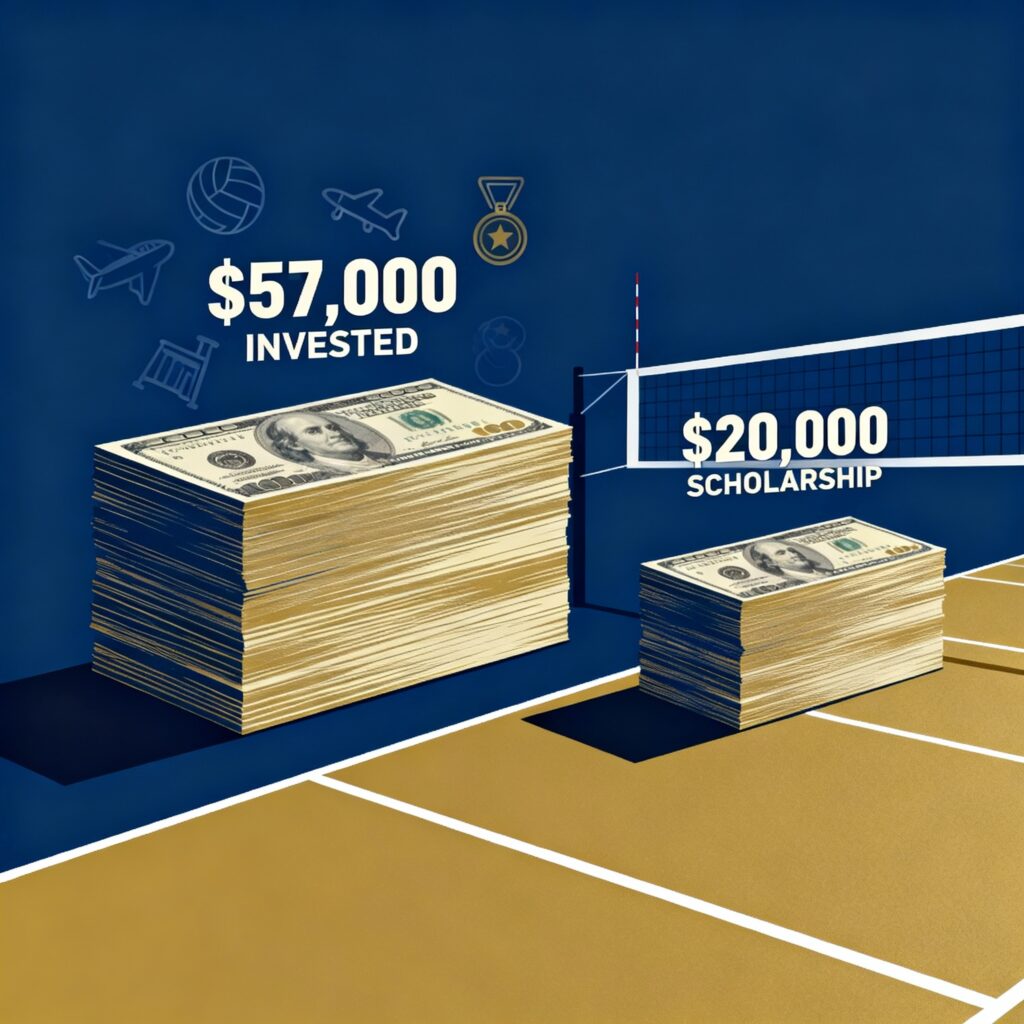
Total investment: $57,000
Then the recruiting conversations actually start.
Division I schools are showing interest, but the offers aren’t what you expected:
Division II schools are offering similar amounts:
One Division III school (no athletic scholarships) is offering the most generous package: $35,000 per year in academic scholarships.
The math hits you like a freight train:
Best athletic scholarship offer: $5,000/year × 4 years = $20,000 total
Your investment to get there: $57,000
Return on investment: -$37,000
You paid $57,000 to get $20,000 back.
But here’s the twist that makes it even worse: When you look at the academic scholarship offers, you realize your daughter’s 3.7 GPA and solid test scores were opening doors that volleyball couldn’t. The Division III school offering $35,000/year in academic money—that’s $140,000 over four years. Her grades were worth seven times more than her best athletic scholarship offer.
And you think: What if we’d invested even half that $57,000 in test prep, academic tutoring, and enrichment programs instead? How much more academic scholarship money might she have qualified for?
Now you’re facing a decision:
Take the $5,000/year athletic scholarship at a Division I school that’s not her top academic choice?
Or take the Division III school with $35,000/year in academic money where she can still play volleyball—just without an athletic scholarship?
She chooses the Division III school. It’s the right choice academically and financially. She’ll play volleyball. She’ll get a great education. She’ll graduate with minimal debt.
Her story has a happy ending.
But you can’t help thinking: Someone should have told us the truth four years ago.
The time she spent in extra volleyball training could have been spent building her academic resume. The $57,000 invested in chasing athletic scholarships could have been invested in academics—or just saved for tuition.
Nobody warned you because the system doesn’t want you to know.
The club made money every year. The tournament organizers made money. The recruiting services made money. The showcase events made money.
The only people who didn’t make money were you—the parents who believed the dream was realistic for your daughter.
This isn’t a cautionary tale. This is the typical outcome for families who invest in club volleyball expecting a meaningful athletic scholarship return.
The ones who end up happy are the ones who eventually realize: the scholarship was never the point. The character development, the life lessons, the experience—that was the real value. But they wish someone had told them that upfront instead of letting them chase scholarship money that was never coming.
If you’re going to invest in club volleyball with college recruiting as a goal, you need to understand the real numbers and make decisions with your eyes open.
Here’s the framework I use with families:
High school to college pipeline:
Division breakdown of those 25,000:
Full-ride scholarships:
Extremely rare. Most Division I programs have 12 scholarships to split among 15-20 players. Even elite athletes often get partial scholarships.
Your daughter’s realistic odds:
These aren’t my numbers. These are NCAA numbers.
Use this formula:
Total club investment (club fees + travel + training + gear × number of years)
vs.
Realistic scholarship potential (average scholarship in your daughter’s realistic division × 4 years)
Example:
You’re paying $60,000 to get $24,000 back.
Would you make that investment in the stock market? No. So why make it in volleyball?
I’ve talked to dozens of college coaches. Here’s what they actually look for:
Before you spend another dollar on club volleyball with recruiting as the goal, ask these questions:
About your daughter:
Once you have real numbers, make one of three choices:
Do this if she has elite measurables, is getting interest, genuinely loves volleyball, AND you can afford it without stress while accepting low scholarship odds.
Value character development, life skills, fitness, and social connections—but stop pretending it’s about scholarships.
Choose school volleyball only, recreational programs, less expensive clubs, or invest the money elsewhere.
Here’s what many families discover too late:
The $60,000 you’d spend on club volleyball could instead fund:
Many students will receive more scholarship money from improved test scores and GPAs than they ever would from athletic scholarships.
I’m not telling you not to do club volleyball. I’m telling you to stop doing it for the wrong reasons.
Do club volleyball because your daughter genuinely loves it, you value the character development, you can afford it without stress, and you’re okay with the investment regardless of college outcomes.
Don’t do club volleyball because you think it’s the path to a scholarship, you’re trying to “pay for college” through athletics, the club director promised your daughter will play in college, or you’re afraid she’ll “fall behind” without it.
The recruiting industrial complex wants you confused about the odds. They want you investing based on hope instead of reality. They want you spending $60,000 chasing a $12,000 return.
Know the real numbers. Make decisions with your eyes open. Invest intentionally, not desperately.
And remember: your daughter’s worth isn’t determined by whether she plays college volleyball. Her character, her education, her relationships, her happiness—those matter infinitely more than any scholarship.
Before you commit to another season with “college recruiting” as your goal, do this:
If you want help navigating these decisions and connecting with other parents who are asking the same questions, join the LOVA Community.
Inside the Parent Lounge, parents share real scholarship offers, recruiting timelines, academic vs. athletic scholarship comparisons, and support for making tough decisions.
→ Join the LOVA Community Now (Free)
Stop chasing myths. Start making decisions based on reality.
________________________________________________________________________________
Coach Carlos is an Olympic athlete who represented Venezuela at the Beijing 2008 Olympics, played professionally for 15 years across 10 countries, and has coached hundreds of athletes at the club and national levels. He created the LOVA Community to give parents the truth about club volleyball—including the recruiting realities that clubs don’t want you to know.